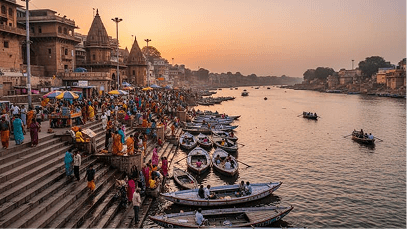
If this is your first Kumbh, the scale of it can be hard to picture. The Nashik Simhastha Kumbh Mela 2027 is expected to draw crowds in the range of fifteen to twenty crore over its span, one of the largest gatherings of human beings anywhere on earth, come to bathe in the sacred Godavari at a moment the tradition holds especially holy. It happens at Nashik just once every twelve years; the next one isn't until 2039.
That's the daunting part. The reassuring part is that millions of ordinary families, first-timers included, make this pilgrimage and come away moved rather than overwhelmed. The difference is almost entirely preparation. This guide is your orientation: what the Kumbh actually is, what to expect when you arrive, the handful of decisions that shape everything, and the missteps to avoid. Think of it as the map before the journey, each section points you to a fuller guide.
What the Kumbh is, briefly
The Kumbh Mela is a mass Hindu pilgrimage centred on a holy bath, a snan, in a sacred river. It rotates between four cities (Prayagraj, Haridwar, Ujjain, and Nashik) on a roughly twelve-year cycle governed by the positions of Jupiter, the Sun, and the Moon. At Nashik, the festival is called the Simhastha, because it falls when Jupiter is in Simha (Leo).
The heart of it is the snan. On the most auspicious days, the Amrit Snans, the akharas (the ancient orders of ascetic monks) process to the water in ceremonial order and bathe first, followed by millions of lay pilgrims. To bathe in the Godavari on these days is believed to carry profound spiritual merit. Our dates guide explains the dates and their meaning.
What makes Nashik's distinctive
One thing every first-timer should understand: the Nashik Simhastha happens at two sites, not one. The Vaishnava akharas bathe at Ramkund in Nashik, on the Godavari. The Shaiva akharas, including the dramatic Naga sadhus, bathe at the Kushavarta Kund in Trimbakeshwar, 28 km away, where the Godavari rises and one of the twelve Jyotirlingas stands. The two run in parallel. For most first-timers, Nashik's Ramkund is the centre of the trip, with Trimbakeshwar as an essential day's pilgrimage; our Trimbakeshwar Jyotirlinga guide covers the second site.
What to expect when you arrive
Be ready, in your mind, for three things.
A demanding, physical few days. Warm, humid weather (the 2027 snans fall in the monsoon tail), a great deal of walking, early pre-dawn starts, and long hours on your feet. Pace yourself. An atmosphere that's hard to describe. The devotion, the sadhus, the processions, the lamps on the river at dusk — first-timers consistently find it overwhelming in the best sense. Allow yourself time simply to take it in.
The five decisions that shape your trip
Get these right and the rest follows.
- 1. Your snan date. The single most important choice. The three Amrit Snans are 2 August, 31 August (the peak), and 11–12 September 2027. The 31 August peak is the most charged and the most crowded; the others, and the quieter Parva Snans, are gentler. First-timers, and especially families, should weigh a calmer date. See our dates and best time to visit guides.
- 2. Where you stay. Proximity to Ramkund matters more than room comfort, because vehicles can't reach the ghats on snan mornings. Book early, four months ahead for the peak. See our hotels near Ramkund guide.
- 3. How you travel. Book transport in parallel with your room; trains and Mela-season flights fill fast. Find your home city in our travel guides.
- 4. What to pack. Pack for heat, rain, crowds, and a holy dip, with a dedicated snan kit. See our packing checklist.
- 5. How long to stay. Five days is comfortable for the snan, Trimbakeshwar, and the sacred sites; three is the workable minimum. Our 5-day flagship plan lays it out day by day.
If you do nothing else, book accommodation and travel early. They are the things that sell out, and the peak day is the hardest.
Book your room early — it's the thing that sells out
Rooms near Ramkund go four months ahead for the peak. Lock a close-in base before you sort anything else.
Check availability →The mistakes first-timers make
Learn from the common ones:
- Arriving on the morning of the snan. The snan begins before dawn, and the Mela traffic is impossible. Arrive the day before, at the latest.
- Staying too far from the ghats. A comfortable hotel 8 km away becomes a long pre-dawn walk on snan morning. Proximity beats luxury for the Kumbh.
- Booking too late. Rooms near Ramkund and Mela-season transport go months ahead. Waiting means paying more for worse, or finding nothing.
- Underestimating the crowds and the heat. Both are more intense than first-timers expect. Plan for rest, hydration, and crowd safety.
- Trying to do everything. The snan and Trimbakeshwar are the heart of it. Don't cram; a calmer trip is a better one.
- Visiting Trimbakeshwar on a snan day. For the Jyotirlinga darshan, go on a quiet day instead — the queues are a fraction.
Staying safe, healthy, and respectful
Three short pointers, each with its own guide. Safety in crowds: agree meeting points, carry contact cards for children and elderly, and learn the basics of moving safely in dense crowds (see our crowd safety guide). Your health: hydrate, mind food and water hygiene, care for your feet, and carry your medication (see our health precautions guide). Respect and etiquette: understand how the bathing works, dress modestly, and be considerate of the akharas, the sadhus, and fellow pilgrims, including around photography (see our bathing etiquette guide).
Is it safe for a first-timer? Yes, with planning
It's natural to feel apprehensive about a gathering this size. But the Kumbh is a heavily managed event with extensive administration, medical posts, crowd control, and help points throughout. Millions of first-timers, families, and elderly pilgrims make the journey safely every cycle. Prepare sensibly, choose your date and base wisely, respect the crowds, and you'll be fine — and very likely moved by it.
Frequently asked questions
I've never been to a Kumbh. Is it safe for a first-timer?+
Yes, with preparation. It's a vast but well-managed event with medical posts, crowd control, and help points. Choose a calmer snan date if you're nervous about crowds, stay close to the ghats, follow basic crowd-safety habits, and you'll be in good company — millions of first-timers make the trip each cycle.
When is the Nashik Kumbh 2027, and which day should I aim for?+
The three Amrit Snans are 2 August, 31 August (the peak), and 11–12 September 2027, within a Mela running from late October 2026 to mid-2028. First-timers wary of crowds should consider the quieter 2 August or 11–12 September dates, or a Parva Snan.
How many days should a first-timer plan?+
Five is comfortable, three is the minimum. Five lets you do the snan, Trimbakeshwar, and the sacred sites without rushing.
What's the one thing I shouldn't get wrong?+
Book accommodation and travel early, and stay close to Ramkund. Proximity to the ghats matters more than comfort for the Kumbh, because vehicles can't reach them on snan mornings.
Do I have to be Hindu to attend?+
The Kumbh is a Hindu pilgrimage, but it draws visitors of all backgrounds. If you're attending respectfully, dress modestly, follow the etiquette, and be considerate of pilgrims and the akharas.