
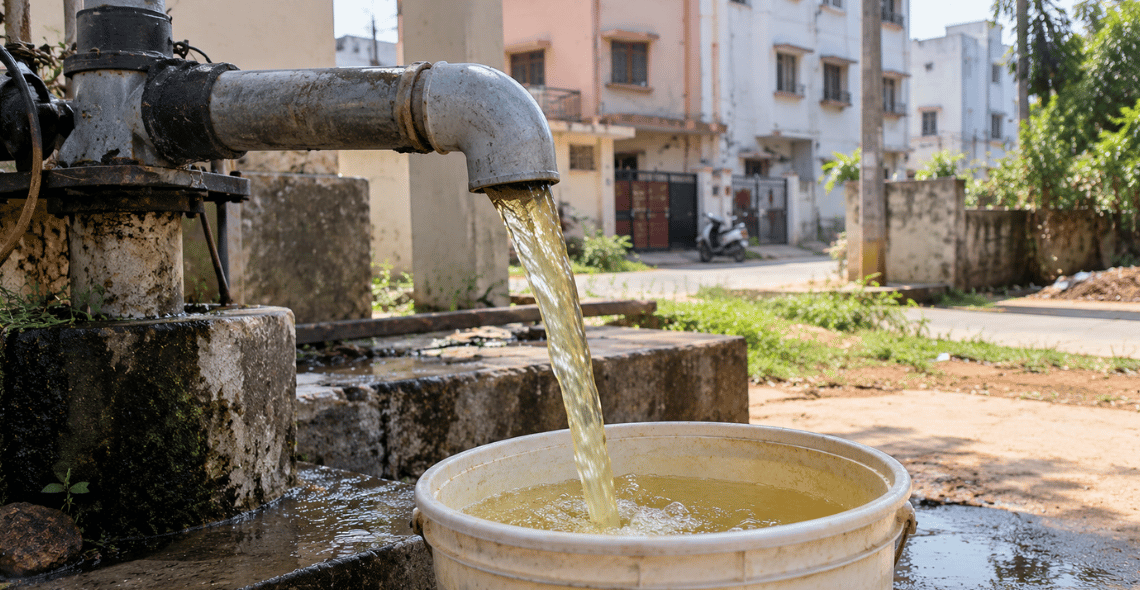
Groundwater contamination in Dattanagar, near the Ambad industrial area in Nashik, has raised concerns after residents reported yellowish water from their borewells. Laboratory tests reportedly found chromium levels far above the prescribed drinking-water limit, prompting action by the authorities.
The National Green Tribunal (NGT) has now sought an action-taken report from the Maharashtra Pollution Control Board (MPCB) and Nashik district collector within four weeks. The case also raises questions about drinking-water safety and pollution control ahead of Nashik Kumbh Mela 2027.
Key Highlights
Residents reported yellowish borewell water in Dattanagar.
Groundwater samples reportedly showed chromium levels of 45 mg per litre, against a drinking-water limit of 0.05 mg per litre.
NGT has sought an action-taken report within four weeks.
The district collector has been directed to address safe drinking-water needs in affected areas.
The case raises concerns about protecting the Nandini–Godavari river system, but contamination of river bathing water has not been established by the information available.
Yellowish Borewell Water Raises Alarm
Residents of Dattanagar and nearby areas raised concerns after noticing yellowish or discoloured water coming from their borewells. The change in water appearance led to concerns about groundwater quality and possible health risks.
According to reports, testing by the Maharashtra Pollution Control Board on October 8 found chromium concentrations of 45 mg per litre in two groundwater samples. The reported level is significantly higher than the prescribed drinking-water limit of 0.05 mg per litre.
The colour of the water alone cannot identify the contaminant. Laboratory testing is needed to determine the presence and concentration of specific chemicals.
NGT Seeks Action from Authorities
The National Green Tribunal has directed the MPCB and Nashik district collector to submit an action-taken report within four weeks. The report is expected to address the steps taken to investigate the contamination and respond to the concerns raised.
The proceedings bring attention to the need for effective monitoring, investigation and action where groundwater pollution is suspected.
Safe Drinking Water for Affected Residents
Providing safe drinking water is an immediate concern for residents in the affected area. The district collector has been directed to address potable-water needs while the contamination issue is being dealt with.
Residents should follow official advisories about the use of local borewell water. The reported chromium findings make it important to rely on verified water-quality information rather than judging safety by colour or appearance alone.
Concerns About River-Water Safety
The case also raises questions about possible risks to the Nandini–Godavari river system. The legal application reportedly seeks restrictions on bathing and drinking-water extraction from relevant river stretches unless the water is certified safe.
These requests should not be presented as a confirmed bathing ban. A specific decision on the requested restrictions has not been established from the available report, and groundwater contamination does not by itself prove that the river bathing areas are contaminated.
Why the Issue Matters Ahead of Nashik Kumbh Mela 2027
Nashik and Trimbakeshwar are preparing for Nashik Kumbh Mela 2027, when large numbers of pilgrims are expected to visit the region. Safe drinking water and proper monitoring of water quality will be important public-health priorities.
The NGT proceedings are focused on the groundwater contamination issue and the response by local authorities. Further investigation and verified water testing will be needed to establish the extent of contamination and determine whether any wider water-safety measures are required.