
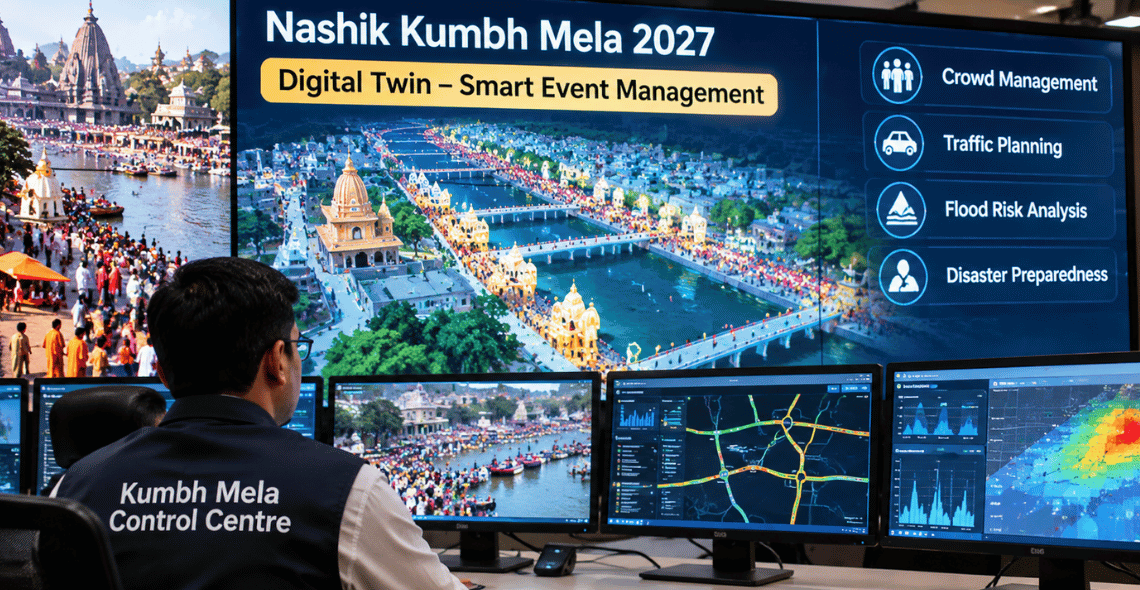
The Nashik-Trimbakeshwar Kumbh Mela Authority is exploring Digital Twin technology to improve crowd management, traffic planning and disaster preparedness for Nashik Kumbh Mela 2027.
An interdepartmental workshop was organised on Tuesday to discuss the use of this technology during the upcoming Simhastha. The proposal involves creating virtual models of important locations, including river ghats, roads, parking areas and holding zones. These digital models could help the administration understand crowd movement, predict traffic congestion and prepare for possible emergencies.
Key Highlights
Digital Twin technology is being considered for Nashik Kumbh Mela 2027.
Virtual models of ghats, roads, parking areas and holding zones are planned.
The system could help predict crowd density and traffic congestion.
Flood-risk analysis and evacuation planning are among the proposed uses.
Existing CCTV networks and the Integrated Command and Control Centre (ICCC) may be connected to the system.
Police, municipal and district administration officials attended the workshop.
What Is Digital Twin Technology for Nashik Kumbh Mela 2027?
Digital Twin technology creates a virtual representation of real-world locations and infrastructure. It allows authorities to study how different situations may affect a particular area before they happen.
For Nashik Kumbh Mela 2027, the proposed system would create digital models of important locations connected with the event.
These may include:
Godavari river ghats
Main roads and narrow streets
Parking facilities
Holding areas for devotees
Important public infrastructure
Using information about crowd movement, vehicle numbers and available facilities, officials could assess the pressure on different locations and plan suitable responses.
Digital Models of Ghats, Roads and Parking Areas
One of the main discussions during the workshop focused on preparing virtual models of important Kumbh Mela locations.
The proposed system could help officials understand crowd density at different ghats, monitor the movement of devotees and assess traffic flow around important roads.
It could also help identify how a problem at one location might affect nearby areas.
For example, if a particular ghat becomes overcrowded, officials could use the digital model to study the impact of restricting entry and redirecting devotees to other locations.
Similarly, parking capacity could be compared with the number of vehicles arriving at different locations to anticipate possible traffic queues.
Flood Risk and Emergency Evacuation Planning
Flood management is another important area where Digital Twin technology could support the administration.
During the workshop, officials discussed using previous years' data and information about water releases from dams to estimate which river ghats could be affected by rising water levels.
The proposed system could help assess:
Which ghats may face a flood risk.
How many devotees may be present in affected areas.
How much time may be required to move people to safety.
Which alternative routes could be used during an emergency.
When entry to vulnerable ghats may need to be restricted.
This type of advance analysis could help officials prepare evacuation plans before an emergency occurs.
Predicting Crowd Movement and Traffic Congestion
Managing large crowds and vehicle movement will be a major responsibility during Nashik Kumbh Mela 2027.
The proposed Digital Twin system could help coordinate the movement of devotees from holding areas towards the river ghats.
It could also compare the capacity of parking facilities with the number of incoming vehicles to identify the possibility of traffic congestion.
The workshop also discussed using virtual simulations to understand how closing a particular ghat might affect nearby roads, bus services and parking areas.
Such analysis could help the administration consider alternative arrangements before making decisions on the ground.
Existing CCTV and Control Centre Systems to Be Used
Instead of creating an entirely new system, the administration discussed making better use of existing infrastructure.
The proposed Digital Twin system could be connected with:
Existing CCTV camera networks
Integrated Command and Control Centre (ICCC)
Information systems used by different government departments
Data related to crowd movement and public facilities
The workshop also discussed sending alerts to concerned officers according to the situation. A mechanism to inform senior officials when required action is delayed was also considered.
The proposed approach aims to improve coordination between the police, municipal corporation and district administration.
Senior Officials Attend Interdepartmental Workshop
Several senior officials and expert consultants participated in the workshop organised by the Nashik-Trimbakeshwar Kumbh Mela Authority.
Those present included:
Sandeep Karnik, Police Commissioner
Shekhar Singh, Kumbh Mela Commissioner
Manisha Khatri, Municipal Commissioner
Ayush Prasad, Nashik District Collector
Dr. D. S. Swami, Superintendent of Police, Nashik Rural
Kamalakar Randive, Additional Commissioner
Uday Kisve, Additional Commissioner
Nilesh Bhadane, Additional Municipal Commissioner
Kiran Chavan, Deputy Commissioner of Police
The participation of officials from different departments reflects the importance of coordination in planning crowd management, traffic arrangements and emergency response for the upcoming Simhastha.
Technology-Based Planning for Nashik Kumbh Mela 2027
The proposed use of Digital Twin technology represents an effort to bring data-based planning into Nashik Kumbh Mela 2027 preparations.
By creating virtual models of important locations, the administration could study different situations, identify possible risks and plan responses in advance.
The discussions also highlight the importance of connecting existing surveillance and command centre infrastructure with information from different departments.
The next important step will be the development and implementation of the proposed system and its integration into the wider Kumbh Mela management arrangements.